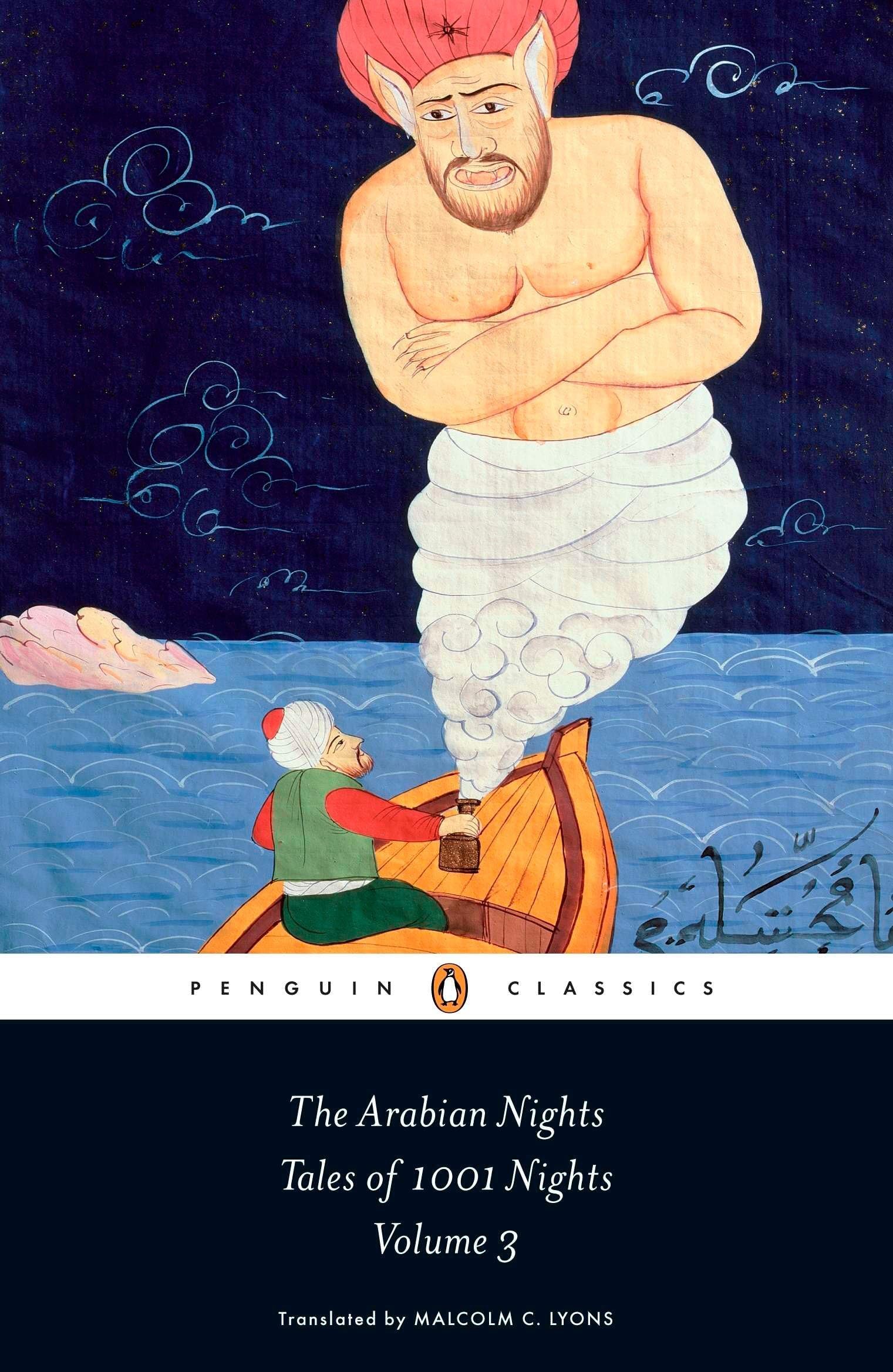
The Arabian Nights: Tales of 1,001 Nights: Volume 3
Desertcart purchases this item on your behalf and handles shipping, customs, and support to China.
Description
Every night for three years the vengeful King Shahriyar sleeps with a different virgin, executing her next morning. To end this brutal pattern and to save her own life, the vizier's daughter, Shahrazad, begins to tell the king tales of adventure, love, riches and wonder - tales of mystical lands peopled with princes and hunchbacks, the Angel of Death and magical spirits, tales of the voyages of Sindbad, of Ali Baba's outwitting a band of forty thieves and of jinni s trapped in rings and in lamps. The sequence of stories will last 1,001 nights. Review: Please read these great ancient yet contemporary classic set - Quite a great trilogy ,deep tales that strike a chord with us without a doubt Review: Awesome - Awesome book











Specifications
| Best Sellers Rank | #24,543 in Books ( See Top 100 in Books ) #347 in Myths, Legends & Sagas #396 in Literary Theory, History & Criticism #1,064 in Classic Fiction (Books) |
| Customer Reviews | 4.7 out of 5 stars 244 Reviews |
Reviews
A**G
Please read these great ancient yet contemporary classic set
Quite a great trilogy ,deep tales that strike a chord with us without a doubt
D**V
Awesome
Awesome book
S**M
Five Stars
Gave my combined review for the first volume.
A**Y
Five Stars
GREAT!
R**L
Un clasico
Todo perfecto
I**K
Essential reading
I was amazed when I started reading these stories at how delightful they were. They're for adults - sexy, violent, political... if you like folklore, you'll really enjoy them. I have an earlier (1951) version translated from the French and this newer translation is for the most part better: the writing is crisper, cleaner and smoother. You'll want all three volumes, too.
I**S
Another volume of epic entertainment
A few years ago I read an abridged version of the 1001 Nights, which was originally published by Penguin Classics in the 1950s. I liked it so much I decided to read the whole thing, which is now published by Penguin Classics in a more modern translation from 2005-8. Be warned, though. The unabridged version runs to three volumes, each of around 900 closely printed pages. Volume III covers nights 719 to 1001 and also gives us the tale of Sindbad and his magic lamp. This edition has a useful introduction describing the influence that the tales have had on a wide range or writers over the centuries, as well as a glossary and some maps of Baghdad and Cairo, two cities frequently mentioned in the text. If you think that Shahrazad tells 1001 separate tales, you’ve been led astray. What you get across all three volumes are a serious of tales within tales within tales. Some of the tales last for forty or fifty nights or even longer. There is a theme of good triumphing over evil. Good people live long, happy lives; bad people go to hell. But bad people cause a lot of suffering before making their trip downstairs, and it’s the good people who suffer. There is a useful index at the end covering all the tales and showing those tales that are tales within tales. Splitting the tales into “nights” is a handy device because it splits them into bite-size chunks. Some “nights” are shorter than others – barely a page in some cases, though I noticed in this volume that many “nights” last more like three pages – some even longer. The “nights” are also a reminder that Shahrazad’s life is on a knife edge. If she fails to entertain the tyrannical King Shahriyar on any night, she faces the chop. Fortunately, she is a narrator of genius and the demanding king and demanding reader are equally entertained. I noted in Volumes I and II that black characters are frequently associated with wickedness and ugliness. In this volume that is not so apparent but there are frequent references to black eunuchs and slaves, though there are also white slaves. I’ve also noted that male and female beauty are often described in similar terms. There is a strong homoerotic element in some stories. There is also a lot of wine drinking. And music. Both men and women compose poetry, though most of the singing of that poetry is done by women playing a lute. There is much delight in gold, silver, precious gems, palaces and political power. There are early signs of global capitalism with lots of trading going on resulting in big profits. There are women living independently, often with vast wealth, and making their own decisions about marriage. There are women who are highly intelligent and inventive. Preconceptions about Islam have to be parked rather rapidly, though it has to be said that Christians, Jews and Zoroastrians get a bad press. It’s an entertaining mishmash of marvellous tales on an epic scale and having finished all three volumes I feel is if I’ve read one of the truly great works of world literature. That’s an achievement and a very worthwhile and enjoyable one.
K**N
Fabulous, in every sense of the word
I've been reading this translation off-and-on since late 2010. It has been a magnificent reading experience. Certainly there are formulaic elements in THE ARABIAN NIGHTS. The characters tend toward the stereotypical: there's the handsome naïve but perseverant hero, the beautiful princess, the wily vizier, the temperamental sultan, and the wicked magician. Things seem to happen in threes. Certain situations become commonplace: Any net cast is destined to eventually haul in a cache of treasure, a talking fish, or some magical object. If there's a door and someone says, "never open that door," you can bet your life that before the story is over that door is going to be opened. The supernatural elements are everywhere and we see alien societies of beings with super powers who can thrive underwater, or on high mountains, or in secret caves. Dickensian coincidences abound. And I came to love every bit of it the same way I loved fairy tales as a child. The language is formulaic, too. "Morning now dawned and Sharazad broke off from what she had been allowed to say" begins virtually every story. I loved "to hear is to obey, "and "they lived happily until they were visited by the destroyer of delights." The stories in this final volume seem more "literary" than those of the previous two volumes. The big difference is the abundance of poetry. The great American librettist/lyricist Oscar Hammerstein II said of writing musicals that the characters should only sing when the emotion is so big that speech alone does not suffice. That is the way verse is used this volume. Older translations usually omit these verses, which is too bad because it lifts these stories to a higher plane. The alternative is swooning. The heroes swoon quite often in these stories, sometimes to comic effect. The ladies, however, are often daring, bloodthirsty, and incapable of fatigue. Miriam the sash-maker at one point disguises herself as a man using a horrifying technique later perfected by Hannibal Lechter! These tales also include a great deal of information about the lives of common people that is embedded in these stories. One can learn a lot about such things as their diet, their homes, and their daily habits. This was especially evident to me in the long "orphan story" of Aladdin, translated by Ursula Lyons, which is also in this volume. Aladdin is a street urchin until he is taken under the wing of a magician with an ulterior motive. But the magician takes him out of the slums and among respectable people so that he can observe their behavior and learn how to get along in polite society. This is a great work of literature that has influenced many cultures. It is a book to be read again and again. Five stars.
N**B
Good book
A great collection of tales
Common Questions
Trustpilot