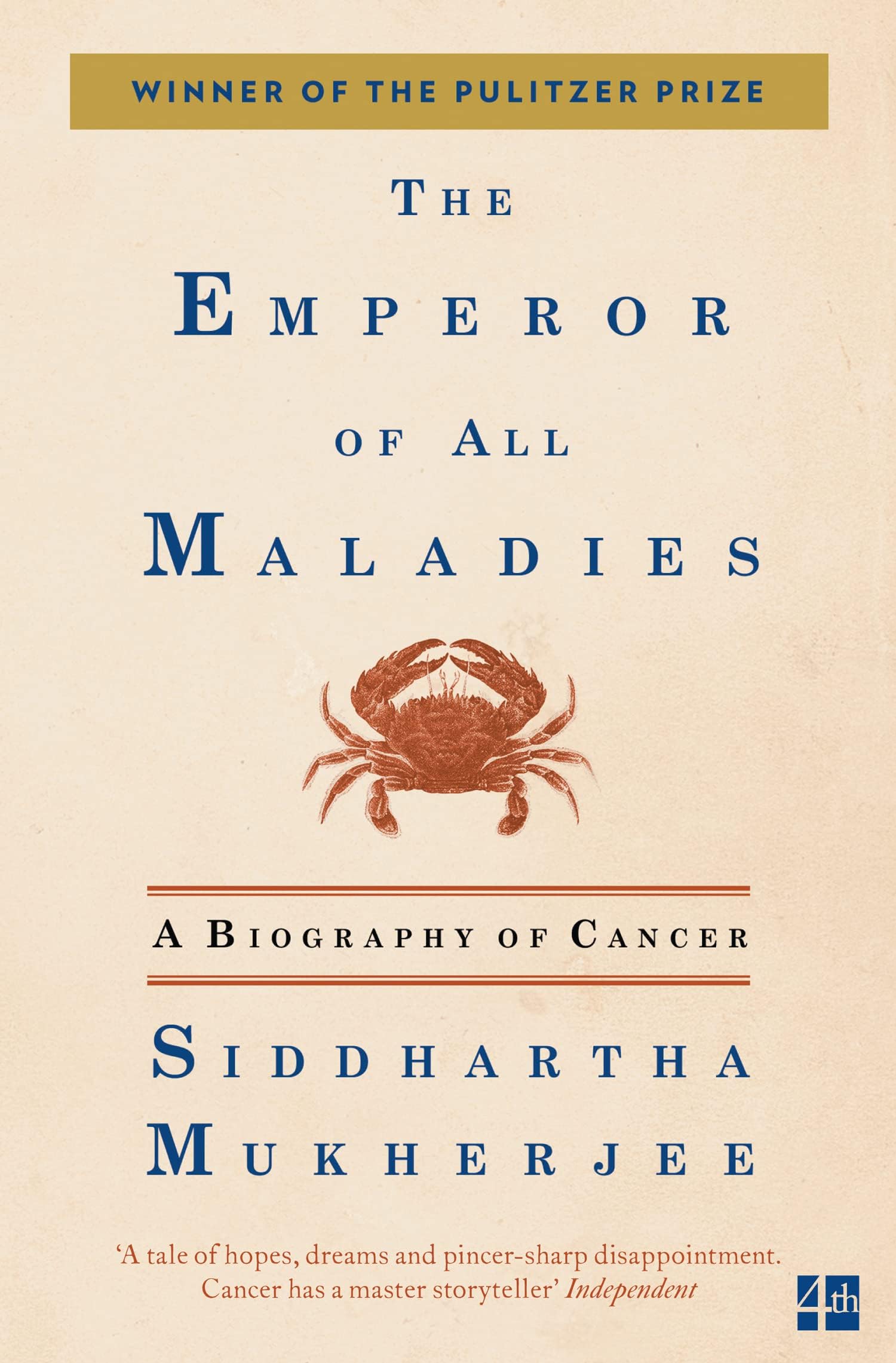
The Emperor of All Maladies: A Biography of Cancer
Product ID: 48754989
🏆Pulitzer Prize Winner
📚Masterful 400+ pages
🧬In-depth cancer biology
Buy anything from 5,000+ international stores. One checkout price. No surprise fees. Join 2M+ shoppers on Desertcart.
Desertcart purchases this item on your behalf and handles shipping, customs, and support to China.
📖 Unlock the epic saga of cancer — knowledge is the ultimate power move.
The Emperor of All Maladies is Siddhartha Mukherjee’s Pulitzer Prize-winning biography of cancer, combining rigorous science, historical depth, and human stories to illuminate the disease’s 5,000-year battle with humanity. This 400+ page masterpiece is a must-read for professionals and anyone seeking a profound, clear understanding of cancer’s past, present, and future.


| Best Sellers Rank | 182,730 in Books ( See Top 100 in Books ) 23 in History of Science (Books) 34 in Medical Biographies 60 in Living with Cancer & Illnesses Biographies |
| Customer Reviews | 4.7 out of 5 stars 9,482 Reviews |
J**E
Gosh…
During the research for my own book, 'The Edge of Sleep,' I repeatedly encountered references to Siddhartha Mukherjee’s 'The Emperor of All Maladies.' This seminal work offers an in-depth exploration of cancer, the oldest malady humanity has had to contend with. As a medical professional specialising in the surgical removal of cancer, I realised just how much I had yet to learn about this pervasive affliction. Cancer touches us all; almost everyone knows a family member or friend who has been affected by it. Understanding its causes and our increasing propensity to suffer from it as we age is crucial. Mukherjee's book is not a scare tactic but a profound revelation that provides a deeper understanding of cancer. It offers rational explanations for why we might develop cancer, making the disease less of an enigma. The book is exceptionally well-written, accessible to both medical professionals and laypersons alike. Mukherjee has a gift for demystifying the complex nature of cancer, making it digestible without oversimplifying, worth the Pulitzer indeed. For medical students, individuals who know someone undergoing chemotherapy, or those who have personally battled cancer, this book offers invaluable transparency. It is a reminder that cancer is not a monolith; there are many different types that can affect various aspects of human physiology. Mukherjee's analogy of Imhotep, the ancient Egyptian physician treating cancer, underscores the long history humanity has endured with this disease. It’s a stark reminder that cancer is not a new or worsening epidemic but a persistent adversary that remains as other diseases have been subdued or eradicated by medical advancements. 'The book also sheds light on the evolution of cancer treatment. In the modern era, we often talk about cancer as if it’s an epidemic. However, Mukherjee emphasises that our increased lifespan and the reduction of other deadly diseases have made cancer more prominent. The book highlights that treating cancer is something we, as a civilization, have become proficient at, whether by curing specific types or managing symptoms. This work is a testament to human ingenuity and resilience in the face of a relentless disease. Mukherjee's narrative is both historical and personal, blending scientific rigor with poignant human stories. The book delves into the biology of cancer, the history of its treatment, and the ongoing quest for a cure. It is an epic tale of scientific discovery, medical progress, and the enduring hope for a future where cancer is no longer a formidable foe. The book is an essential read for anyone touched by cancer, directly or indirectly. Mukherjee has crafted a masterpiece that illuminates the complexities of cancer and our ongoing battle against it. It is a book that adds depth to our understanding of the disease and instills a sense of hope and determination in the fight against cancer. It also informs us, that we must learn to live with it because eliminating cancer is something which is probably, impossible.
R**A
Nonfiction at its best
Popular science (or nonfiction) has become a genre, probably the most popular these days. See the best-sellers newspaper lists or the desks of any major bookshop and those will be plagued with the new form of nonfiction. Where before we were offered "how to guides" (how to get rich, thin, a better lover or parent) now we have perhaps better choices in the form of studies on almost everything: types of personalities, control of habits, approaches to group sociology, etc. etc. This is a healthy field, but marred recently by superficial books. This "Emperor of all Maladies", most thankfully, stays at a safe distance of this recent trend of simple and/or rushed books and is already a canonical and exemplary nonfiction treaty of one of the fiercest and more devastating of maladies. It is superb. Everything works in this volume, because the author is an eminency in his field, but he is never patronizing or condescending. He never writes as from a pulpit nor tries to impress the reader with his obviously vast knowledge of the matter at hand. Importantly, Mr Mukherjee never (not once) falls for easy sentimentalism or tries to engage through pity - and falling for this would be easy in a book about cancer. The reader feels at all times that the author is a mere guide with an authoritative voice. And yet some moments do provoke the reader to cringe, almost to suffer: the patient that consols the doctor when all the options for a cure are exhausted; the process of dealing with the empty beds in a children's ward, among others, are parts hard to finish. The prose is at all times pitch-perfect and never falters, even in a 400-plus science book. The voice of the author, and its language, are always clear, personal and sober. The book works also at another level, that of the politics of tackling such a disease. The right way to fight the malady or how to fund the enormous efforts to do so, become long and vapid discussions between bureaucrats and, at points, decades are lost because of lack of focus, pure greed or pettiness. The science is there - since the Egyptians, who spotted the malady yet reached, in 2600 BC !, a shocking conclusion: "Cure? None". This is a very good book that has already raised the bar of nonfiction.
P**D
A must read for anyone interested in cancer
Despite this book being 600 pages long and a rather grim subject, all six of us at our book group were pleased to have read it and felt we had learned a lot. It details the history of cancer and its myriad treatments over the centuries from barbaric operations-without-anaesthetics to modern-day genetics and chemotherapy. We all agreed it was beautifully written and relatively easy to understand. The author, Siddhartha Mukherjee, lightens the load by giving us heartening case studies. Many more children with leukemia are now cured, as are those with scrotum cancer and breast cancer, although the 'war on cancer' as Mukherjee calls it, is far from over. In the end, we learned that we all carry cancer genes in our cells and if we don't die because of cancer but because of some other illness, we will nevertheless die with cancer in our bodies. Something triggers it off and we can help ourselves by not smoking and triggering lung cancer; not climbing up chimneys and triggering scrotum cancer, perhaps not eating too much red meat which might trigger colon cancer (although this is still in investigation stage) and so on. For me, the book is a wonderful story of unsung heroes, those scientists working tirelessly in lonely, windowless basements trying to find the next piece of the puzzle. It reads like a detective novel as the evidence from research is sifted through for clues. Indeed it was so graphic at times, I worried that I might trigger cancer in my own body just by thinking so hard about it!
K**E
A tour de force of a book
I ordered this book after reading a very favourable review in the British Medical Journal. I found it a riveting read. The author's writing is lively and he explains complex ideas with great clarity using terms understandable by a layperson. The sub-title A Biography of Cancer" is apposite as the story reads like the life of a force against which humans have battled for milleniums. The early chapters chart the very early history of the disease in Greek and Egyptian texts; followed by the ideas of hugely influential doctors such as Galen and his theory of Humours that held sway, astonishingly, until relatively recently. One winces at the draconian purging and blood-letting treatments patients suffered in the vain attempt to alter the imbalances of humours that were believed to underlie their disorder or how they survived the butchery that was surgery in the past. Well into the 20th Century doctors seemed powerless to curb or cure the rising tide of cancers that accompanied the increase in longevity for cancer is predominantly an age-related disease. Treatments continued to be drastic: chemotherapy so toxic it nearly killed patients or surgery so radical it left people disabled. The environmental triggers for cancer are also described such as X-rays, asbestos and, above all, smoking. The unwillingness of the medical profession in the 1950s to accept the crystal-clear evidence of the last of these factors is astonishing! Some early triumphs in the 1950s in curing some forms of leukemia gave hope that a universal magic bullet cure would soon be found. I'm old enough to remember the bold 'War on Cancer' project started during the Nixon presidency with the confident belief of finding a cure for cancer if enough money was thrown at it. Sadly, that was not to be: decades of disappointments, false dawns, sadly sometimes due to fraudulent or egotistical researchers, followed before a glimmer of hope and then an explosion of discoveries began to give an understanding of what drives normal cells to mutate into cancer cells. Understanding what controls our normal genes is leading to targeted treatments for different cancers for there is no magic bullet that will cure cancer as had been hoped. However, the newer treatments, such as monoclonal antibodies, to treat specific expressions of cancer causing genes offer hope of better-tolerated treatments that target the underlying biology of cancer cells rather than the former regimes of killing the rapidly proliferating cancer cells a bit more than the normal cells: a sledge-hammer to crack a nut approach. We all fear cancer as a malevolent disease, but don't be put off from reading this book: it's an amazing story and should give hope that it's finally being brought under control.
M**M
Excellent blend of human interest and science
As a Science teacher (retired) I love the clarity and easy reading of this book. He has great communication skills blending real life human interest and science in an absorbing and absorbing manner. The science is simplified so that most people would understand, I am in awe of his achievement in that, having spent 4 decades trying to do the same. For those who want more detail in the science there are plenty of references and bibliography to read further and deeper. The fact that he also has the experience and expertise of a cancer specialist gives him credibility to be read with confidence. I strongly recommend this book to anyone who wants to know more about cancer but doesn't want to be bogged down in the terminology.
J**S
An Extraordinary, Amazing Book
This is probably the best piece of science writing I have ever read. Indeed, what makes it so impressive is its combination of scientific clarity with a most unusual degree of understanding of the human and social dimensions of the story. The writing is intelligent, lucid, and sympathetic, marked by an uncommon ability to convey complex phenomena in a meaningful and comprehensible way. The author's historical approach works wonderfully well, chronicling the development of both understanding of cancer (mostly the realm of scientists) and treatment of cancer (largely the realm of doctors). The book is long, as it had to be given the complexity of the tale, but I found it almost compulsive reading and difficult to put down. The author is clear-sighted and objective in his treatment of the people who played key medical, scientific, political, and advocacy roles in the past 60 years, considering them and their activities - and their successes and failures - objectively and with a fine sense of how they struggled to deal with this brutal, often mysterious, and always frustrating disease. This telling of the human story is strengthened further by his inclusion of cancer sufferers and their experiences, not for pathos or shock effect but to provide an essential additional dimension. This is a book from which I have learned a great deal, not only about cancer and how we have come to better understand it and deal with it, but also about how science and medicine function in the real world. I recommend this book whole-heartedly.
P**R
This book is easy to read
Cancer. The big C. The one word guaranteed to put fear and dread into the human psyche, but just how much do individuals know about it? This book is easy to read. Yes, of necessity it contains some scientific terminology, but the author explains things in simple terms and the text is very engaging. When I was a child, the estimated likelihood of suffering from cancer was 1 in 4 people; these days it is more likely to be 1 in 2 people, so our need to be informed has increased in a short space of time. The history of cancer and the medicinal and therapeutic treatments from ancient times to the 21st century are very well-documented in this book. We see radical breast surgery decline in many cases as screening is now widely used to detect the onset of cancer. We see the discovery of new drugs, their successes and failures and the back to the drawing board decision by researchers who are fascinated by cancer and who devote their careers to finding the cure.The author has been meticulous in his research and, using his own experience as a doctor, has shown that the fight to find a means of eradicating cancer shows no sign of slowing down. Mukherjee shows himself to be a very compassionate man who really engages with his patients and feels the highs and lows of their treatment. The Human Genome project in our own modern era has led to great discoveries about our DNA and individual genetic make up. The author explains that our genes and chromosomes can be damaged by mutation and how cancers arise and spread prolifically in some cases, slowly in others. Indeed, it would seem that future cancer treatment may have to be tailor made to the individual to have maximum effect. Don't be put off by the length of this book. The pages of references are many. The narrative is easy to follow and anyone with an interest in human disease and especially cancer will learn a great deal.
C**S
Very good overview of the history of cancer care and cancer research.
Very well writen and interesting book. Can only recommend this book. It very nicely explains the development of cancer care (in a clinical sense) and cancer research over the centuries. I liked that it also highlighted quite clearly all the failures and detours oncologists and scientists made over the years to finally arrive where we are today. Also well understandable for anyone not in the field. I would have liked a few more pictures around the cell structure to help with understanding. Small shortcoming of the paperback version (hence only 4 points): The letter size is a felt size 7. It would have been benficial to add a couple more pages and have larger lettering.
A**S
Baskı kalitesi ve kitap orjinal.
Ürün çok güzel ve beklediğim gibi geldi. Kitap kalitesi ve baskısı güzel. Teşekkür ederim.
A**S
A must read for anyone digging deeper in understanding cancer
I just finished reading it, and I must say it is definitely worthy of its Pulitzer. THe book features very detailed information (the amount of research needed must have been tremendous), but it is conveyed in a very fluid writing. Dr Mukherjee masterfully guides us through seminal moments in the history of cancer discovery and treatment, highlighting the human characters involved in each of those moments. It's very interesting to see characters and concepts come back again in different moments, often in ways to fill in gaps that seemed obvious in retrospect. The only significant aspect lacking in the book is the role of modern pharmaceutical companies and the government (and professional) entities that regulate them. We see a little bit of it with Genentech and Novartis, and the NCI is a major character in the book. However, the whole of the pharmaceutical industry and agencies like the FDA are not there. This is, nonetheless, a must read for anyone interested in digging deeper into the hows and whys of cancer as it is today. Since it was published in 2010, I would love to see an update (a sort of "sequel") covering the stories of the advancements of the last few years; since it's such a dynamic field.
H**K
An Epic in Elegance: The Literary Power of Mukherjee’s The Emperor of All Maladies
From the very first pages, The Emperor of All Maladies captivates you with a rare blend of scientific clarity, historical sweep, and deeply human narrative. This is not just a medical history — it is a story of hope, suffering, reinvention, and the relentless struggle between life and disease. Beyond its scientific depth and historical scope, the book also shines as a work of literature. The prose is never dull — it is vivid, elegant, and often poetic. Siddhartha Mukherjee transforms what could have been a dense medical chronicle into an engrossing narrative, enriched with imagery and metaphor. His phrasing lingers long after the page is turned. When reflecting on a missed scientific opportunity, he observes: “The two halves of cancer, cause and cure, having feasted and been feted together, sped off in separate taxis into the night.” He defines cancer with striking clarity as “…where cells acquire an autonomous will to increase” and issues the ominous reminder that “Cancer is intrinsically loaded into our genes, waiting for activation.” Lines such as these reveal Mukherjee’s rare gift for making science not only understandable, but luminous and memorable. What Makes It Stand Out 1. Brilliant balance of science and story The author weaves detailed biomedical content (cell growth, oncogenes, molecular pathways) with gripping human stories of patients, doctors, and researchers. The technical details never overwhelm — they enrich the narrative, letting you see cancer not as abstraction, but as a tragic force that touches lives. 2. Immense sweep of history The book traces cancer’s battle from early observations through decades of experimentation, innovation, failures, and breakthroughs. You sense how medicine evolved — the shifting paradigms, the false leads, the incremental advances. This gives one a profound appreciation for how fragile and tentative progress often is. 3. Philosophical resonance The book frames cancer as not merely medical but existential. “Cancer is stitched into our genome… a flaw in our growth, but this flaw is deeply entrenched in ourselves.” Mukherjee makes us ask: can we ever fully eradicate cancer without also eradicating the very processes — aging, repair, regeneration — that sustain life? This questioning elevates the book from a chronicle to a meditation. A key insight: that cancer is, in some way, entangled with our very nature — embedded in processes of growth, aging, repair, mutation. 4. Moments of human resilience Between the science, there are stories of patients, physicians, and scientists — people who persevere, fail, adjust course, sometimes triumph. These human threads provide an emotional anchor. You care. You cheer. The personal dimension is not an afterthought — it is integral. 5. Impressive clarity and structure Even when describing complex processes (oncogenes, chemotherapy, genetic mutation), the author keeps explanations lucid and accessible. “Science embodies the human desire to understand nature; medicine, then, is fundamentally a technological art.” With sentences like this, the book feels like a guided journey, not a lecture. Standout Quotes: “Cancer is stitched into our genome… a flaw in our growth, but this flaw is deeply entrenched in ourselves.” “We can rid ourselves of cancer only as much as we can rid ourselves of the processes in our physiology that depend on growth — aging, regeneration, healing, reproduction.” “Science embodies the human desire to understand nature; medicine, then, is fundamentally a technological art.” “Perhaps cancer defines the inherent outer limit of our survival.” In Short: This book deserves five stars. It is rare to find a work that is at once scientifically ambitious and deeply humane, historically comprehensive and emotionally gripping. If you care about medicine, human suffering, scientific ambition, or just the fragility and resilience of life, this will stay with you long after the last page.
A**O
A beautiful story narrated by a skilful writer
I was looking for some scientific information about cancer, and I stumbled upon this book. I was expecting a somewhat boring chronology of cancer research; I couldn't have been more wrong. The author makes a wonderful job in selecting stories and "storylines", and telling them in an enjoyable style (a well-deserved Pulitzer). You will travel through history and follow the fall of the humoral theory, the rise (and fall) of radical surgery, the rise (and fall) of radical chemotherapy, and the rise of the genetic theory of cancer. It turns out that following the evolution of the scientific understanding of cancer is the best way to learn about it. In addition to cancer itself, the book teaches much about science going wrong: scientific communities following dogmas and being blind to evidence against them; a premature all in battle against cancer (lacking mechanistic understandings); fabrication of data; politics and corporations hampering scientific research; the loss of connection between doctors and patients. A highly suggested read, although the book is slightly outdated now.
E**Y
Insightful read for both science students and general public
Fantastic book. I read this during my undergraduate university years as a biology student studying health and disease. It was incredibly insightful, both for its historical storytelling and the slightly greater focus on the science of cancer compared to other similar books tailored for a general audience.
Trustpilot
4 days ago
2 weeks ago