We remain fully operational. Our teams are working around the clock to ensure your deliveries continue safely.

DOWNLOAD THE APP


Copyright © 2025 Desertcart Holdings Limited
DOWNLOAD THE APP
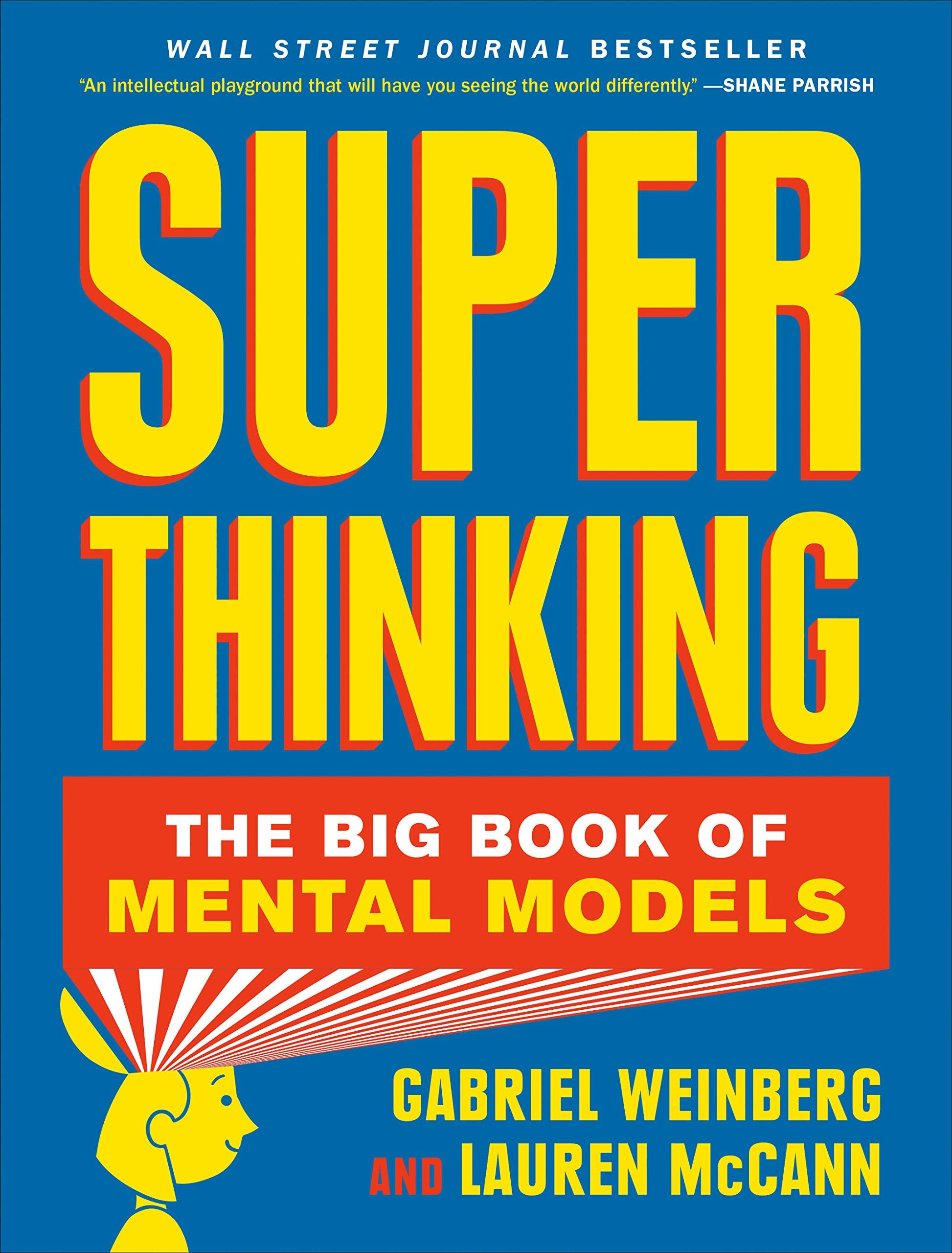
Super Thinking: The Big Book of Mental Models - Kindle edition by Weinberg, Gabriel, McCann, Lauren. Download it once and read it on your Kindle device, PC, phones or tablets. Use features like bookmarks, note taking and highlighting while reading Super Thinking: The Big Book of Mental Models. Review: Good, but not just mental models. Cognitive biases too. - This book promises to discuss mental models and does a good job of that. That's what I was most interested in, as they provide frameworks for thinking and are highly valuable. Partway through, the book starts to include cognitive biases and other quirks of how people think. For that, I wanted to dock a star. These non-model concepts are valuable in themselves but not what I'm here for. They might help you think in a new way, but aren't frameworks for thinking. For example I found the the concept of inertia/momentum/a flywheel personally helpful: “any personal or professional project can be viewed from the perspective of a flywheel. It is slow when you get started on the project, but once you gain some momentum, it seems easier to make progress... when we multitask, we never get enough momentum on any one task for it to start to feel easier.” I ended up giving the book 5 stars because it does help you think differently. Mental models are better for this, but knowing these quirks of human nature help too. It's a good read. Free resources - I also recommend "Model Thinking" on Coursera, some of Nicky Case's "Explorable Explanations", and James Clear's article about mental models. For cognitive biases, look that up on Wikipedia, there are an impressive number there. Review: Might be the most important book in your life - I wish this book was written a bit earlier. 3 years ago when my husband and I moved to the US I started reading as many books on self-development/self-improvement as I could fit in my free time. By this time I've read more than 50 bestsellers on these topics. In 2016 I stumbled upon Gabriel's article on Medium called "Mental models I find repeatedly useful" which is a compilation of many concepts with a short explanation of each one. I would say it's been the best article I've read so far (and I read a lot of them). So, of course, I ordered the book as soon as it became available. I learned some new important concepts from it, but if this book had been available earlier it could have saved me a lot of time. Sure, reading a whole book on one topic could give you more insights and examples to better grasp the concept but at the end of the day you can't retain all nuances in your head and are left with the most important idea from the book. This is what "Super Thinking" is all about - it gives you an array of useful ideas with vivid examples so you could understand every concept without you reading an elaborate 300 pages explanation on every single concept. I would suggest not just read this book and put it on the shelf thinking "okay, I got it, it's simple" (actually all well-explained concepts are fairly simple), but to refer to it as many times as needed until you are completely satisfied with your life and can be proud of yourself. The main point is - we know so much more in theory than we apply in practice. Even the models which look like buzzwords and you think you're already familiar with them - ask yourself if you actually use them. There was a saying of Richard Feynman in the conclusion of this book that there is a difference between knowing the name of something and knowing something. I strongly believe that every person could reach their fullest potential if really applied these models to their every single step, every single decision. If you want to achieve success in every area that's important to you, take "Super Thinking" seriously. Thank you Gabriel and Lauren for this amazing book.


| Best Sellers Rank | #333,111 in Kindle Store ( See Top 100 in Kindle Store ) #268 in Cognitive Psychology (Kindle Store) #345 in Business Decision Making #358 in Business Decision-Making |
B**T
Good, but not just mental models. Cognitive biases too.
This book promises to discuss mental models and does a good job of that. That's what I was most interested in, as they provide frameworks for thinking and are highly valuable. Partway through, the book starts to include cognitive biases and other quirks of how people think. For that, I wanted to dock a star. These non-model concepts are valuable in themselves but not what I'm here for. They might help you think in a new way, but aren't frameworks for thinking. For example I found the the concept of inertia/momentum/a flywheel personally helpful: “any personal or professional project can be viewed from the perspective of a flywheel. It is slow when you get started on the project, but once you gain some momentum, it seems easier to make progress... when we multitask, we never get enough momentum on any one task for it to start to feel easier.” I ended up giving the book 5 stars because it does help you think differently. Mental models are better for this, but knowing these quirks of human nature help too. It's a good read. Free resources - I also recommend "Model Thinking" on Coursera, some of Nicky Case's "Explorable Explanations", and James Clear's article about mental models. For cognitive biases, look that up on Wikipedia, there are an impressive number there.
K**G
Might be the most important book in your life
I wish this book was written a bit earlier. 3 years ago when my husband and I moved to the US I started reading as many books on self-development/self-improvement as I could fit in my free time. By this time I've read more than 50 bestsellers on these topics. In 2016 I stumbled upon Gabriel's article on Medium called "Mental models I find repeatedly useful" which is a compilation of many concepts with a short explanation of each one. I would say it's been the best article I've read so far (and I read a lot of them). So, of course, I ordered the book as soon as it became available. I learned some new important concepts from it, but if this book had been available earlier it could have saved me a lot of time. Sure, reading a whole book on one topic could give you more insights and examples to better grasp the concept but at the end of the day you can't retain all nuances in your head and are left with the most important idea from the book. This is what "Super Thinking" is all about - it gives you an array of useful ideas with vivid examples so you could understand every concept without you reading an elaborate 300 pages explanation on every single concept. I would suggest not just read this book and put it on the shelf thinking "okay, I got it, it's simple" (actually all well-explained concepts are fairly simple), but to refer to it as many times as needed until you are completely satisfied with your life and can be proud of yourself. The main point is - we know so much more in theory than we apply in practice. Even the models which look like buzzwords and you think you're already familiar with them - ask yourself if you actually use them. There was a saying of Richard Feynman in the conclusion of this book that there is a difference between knowing the name of something and knowing something. I strongly believe that every person could reach their fullest potential if really applied these models to their every single step, every single decision. If you want to achieve success in every area that's important to you, take "Super Thinking" seriously. Thank you Gabriel and Lauren for this amazing book.
D**S
Good content, poor production
The book immediately strikes me as super useful to learn about and consider different mental models. It has a good index where the models are bolded. It's a thick book but surprisingly light, because the paper weight is disappointing - the words on the flip side bleed through. A bit disappointing for a book I expect I'll want to revisit as a significant resource.
K**N
Go from thinking to Super Thinking fast with this book!
Gabriel Weinberg's return with - Super Thinking, will have you thinking different in a more profound way. Now partnered with his wife and author Lauren McCann - it is a book that will give you great models to navigate life both personally and professionally. Be prepared to up your game with thinking in general and have a keen thought process with the decisions you make it everyday life. Once I started on this journey by opening the book and reading, it was hard to put down. I found myself using both the hardcover and Kindle edition depending where I was just to get to the end of the book. I wanted to see in anticipation of the next model to the next model and think about how I could apply this to my everyday life. It was a joy to read and I find myself now doing mental exercises on the concepts I picked up in Super Thinking. If you feel like life is full of complexities and you want a solid framework of how to navigate then I strongly suggest you pick up this book. Gabriel is the founder of DuckDuckGo.com and that should tell you enough of the thought he has put into thinking of our world and the privacy issues now coming to light in the world of information we live in. As a bonus, the artwork is great throughout the chapters.
C**R
Good premise but not fully realized.
This book was our monthly book club selection and we all had high expectations but unfortunately it came up short. It must be acknowledged that the authors did a great job at researching and gathering the base material for the subject matter but they failed to go the distance and articulately distill the material down into more coherent and actionable findings. It appears that they got bogged down with the academic exercise and failed to step back and apply some of their own worldly wisdom and perspective. In the early chapters in their apparent commitment to start at the beginning, build a foundation and present a comprehensive view, making no assumptions of the reader, they didn't apply common sense which came across as patronizing, e.g. "You may not realize it, but you make dozens of decisions every day". I call this lazy academia. It's not enough to present your research and leave the heavy lifting up to the reader which is what they did. Our book club collectively spent hundreds of hours doing the "work". One of our group actually took the time to painstakingly map out a color-coded graphical flow chart presenting all the models relative to each other which was a powerful visual aid to interpreting the information. It helped enormously. Also, a number of book summaries available online did a great job in summarizing the material and were able to get to the essence of what the authors were trying to convey in a much more succinct and comprehensible manner. It is a rich and fascinating topic but I would love to see a revised version!
B**D
Valuable Tool Kit
This book is filled with what the authors call "mental models" which are ultimately ways to frame a situation and respond to it based on the framing. They borrow from a wide variety of disciplines and provide a valuable toolkit to assess and act to events. For example, the economics principle of opportunity cost is not well known nor understood, but should always be part of decision making. The cost of dong something is not just the explicit costs (time, expenses) but also the cost of something else that could have been done. This analysis may help reveal another the mental mode of unintended consequences, for example, if taken into account. The book is full of these mental that can be applied to many personal and professional situations. At one point the boo begin to read like a how to manual for start-ups and seems restricted to that audience. Also, many of the tools are very well known and almost cliche. It did provide the clearest explanation I've read of present value. As a whole, however, the book is a must have as a ready reference to consult for meaningful and effective advise.
B**B
Provides Abundant Food for Thought
This book is a fun, light read. It strikes just the right balance between providing enough information and insight to be useful, without getting bogged down in so much analysis and detail that one gets lost. In short, it provides a wide variety of helpful “mental models” and ways of thinking to be productive and effective in the world. Books do no good if they sit on a shelf unread. This one is entertaining enough to be re-read and is useful throughout so you can start reading almost on any page and learn something.
N**N
Good book, but wanted more..
I was very excited to purchase & read this book, because I have been hearing about "mental models" for quite some time. I would like to give 5 stars, but here are the negatives first: 1) I didn't find the first 100 pages all that engaging, already being familiar with many of the concepts, and the light amount of detail presented in regard to each mental model. 2) The remainder of the book was much better, and I'm glad I stuck with it to the end. Overall, I still would have liked to have had much more background on each mental model. Obviously, the book would have been 1,000+ pages in order to go into more depth for each mental model, so I view this as more of an introduction to whet one's appetite to learn about mental models & what some of them are. Then, you could do your own research if you wish to learn more about specific models. All-in-all, I'm glad that I purchased and read this. Having already read & listened to a lot of blogs/podcasts, there was really not much new in this book, but for someone recently exposed to these concepts, it really could provide a "wow!" moment. So, I do recommend this book, but wanted a little more... even though tripling the length of the book really would not have been realistic...
Trustpilot
2 months ago
2 weeks ago